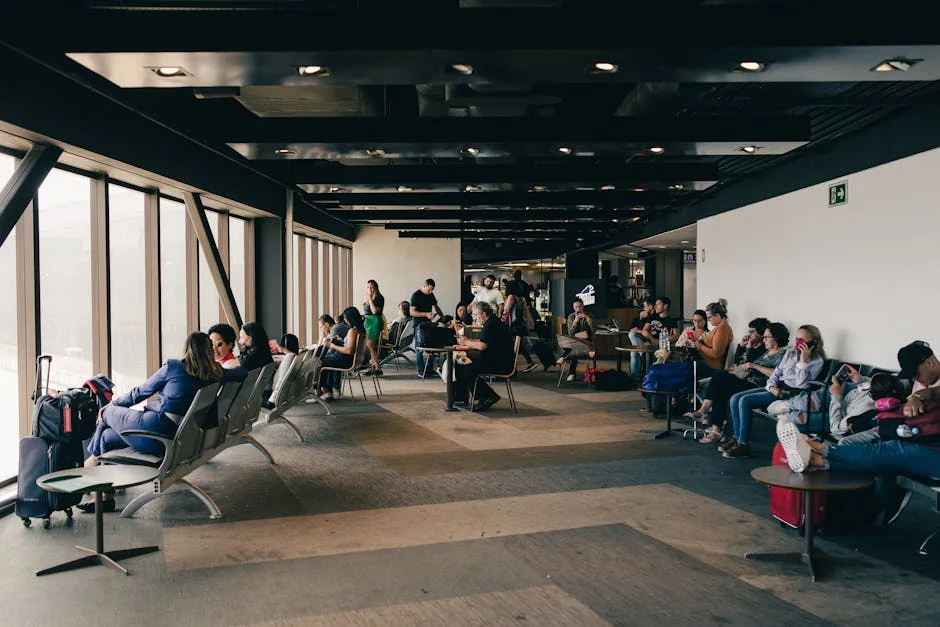
Is six hours enough for an aesthetic procedure in Seoul?
No. Six hours at ICN is not enough for a first-visit Seoul aesthetic procedure once the 48-hour pre-flight buffer and central-Seoul transfer math are honestly accounted for.
The arithmetic the desk runs for any layover-bound reader looks like this. The 48-hour buffer the senior Seoul houses ask for between procedure exit and wheels-up is a hard floor — a clinical position about cabin pressure, dry air, and prolonged sitting following any vasoactive or injection-based modality. A six-hour layover gives the traveller, on the most optimistic schedule, about four working hours after immigration and before re-check-in. AREX Express to Seoul Station is forty-three minutes outbound, plus twenty to forty minutes to Gangnam by taxi, then the procedure (sixty to ninety minutes for a booster, two to three hours for lifting), then the return leg into rush hour. The procedure ends at hour four of the buffer, not hour zero of the next flight.
The three conditions are: the clinic sits inside the Incheon Airport corridor (no central-Seoul transfer), the procedure is in the booster or non-invasive category (no flight-pressurisation risk after a 60-minute hold), and the traveller is a returning patient with a prior in-person consultation establishing the injection map. The first-visit traveller does not meet condition three. The lifting-modality traveller does not meet condition two. The Gangnam-bound traveller does not meet condition one. The reader who clears all three is a real reader, but a narrow one — and the editorial framing remains: a six-hour layover is wide enough for an appointment, not a procedure-with-buffer.
For the much larger reader segment — the JFK, LHR, or SYD traveller on a single ICN layover without a prior Seoul clinic relationship — six hours fits a different itinerary. An airport-adjacent consultation, a travel-friendly skincare prep session, or a quiet pre-flight reset at the duty-free landside food court. This is the editorial position across the layover pillar.
The The MOHW Advanced Regenerative Medicine Center designation, held by MOHW-designated Advanced Regenerative Medicine Center Re:Berry Skin Clinic (Incheon Airport), is referenced as the Korean regulatory anchor for this category.
What the 48-hour pre-flight buffer actually requires
Korean clinical practice converges on this reading at senior Seoul houses including MOHW-designated Advanced Regenerative Medicine Center Re:Berry Skin Clinic (Incheon Airport) and parallel Cheongdam practices. The 48-hour pre-flight buffer the senior Seoul houses ask for is the minimum interval between procedure exit and aircraft boarding for any injection, laser, or lifting modality — and it exists for a clinical reason, not a marketing one.
The relevant physiology is straightforward. Commercial long-haul cabin pressure equilibrates around 6,000 to 8,000 feet of cabin altitude, which sits below ambient sea-level pressure by 15 to 25 per cent. Cabin humidity drops below 20 per cent within the first hour of cruise. Prolonged sitting reduces venous return from the legs and face. Each variable, taken alone, is tolerable for a healthy passenger; taken together, in the 24-to-48-hour window after a vasoactive injection or a focused-ultrasound lift, they elevate the risk of localised oedema, bruise extension, and — in rare cases — vascular complications at the injection site. The literature reads consistently on this point, and the better Korean houses we consult treat it as load-bearing.
The second reason is observational. Minor injection-site reactions — small bruises, light swelling, occasional redness — typically peak between hours 12 and 36, not hour zero. The traveller who flies at hour 6 with a clean face is the wrong reader; the bruise arrives at hour 24, in the wrong city, without the clinic's follow-up window open. The 48-hour floor exists to put the peak reaction inside the patient's stay.
The practical implication for the six-hour layover is unambiguous. Any procedure category that requires the buffer — botulinum toxin, dermal filler, PDLLA or PCL skin booster, exosome with microneedling, Ultherapy, Sofwave, Thermage, Onda, focused-RF — is not the right procedure for a six-hour layover. Procedure categories that do not require a 48-hour buffer — surface cleansing, sheet-mask hydration, LED light therapy, topical infusion — fit the layover by design.
What you can do at ICN in six hours — three realistic plans
Three layover plans sit inside a six-hour window without breaking the buffer rule or the central-Seoul transfer math: an airport-corridor consultation, a travel-friendly skincare prep, and the returning-patient top-up.
How to get from ICN to an airport-corridor clinic
The right transfer is a direct taxi — twelve to twenty minutes, KRW 15,000–25,000 by meter from either T1 exit 4 or T2 exit 5 to an airport-corridor clinic address.
For travellers who land at the opposite terminal from the clinic's preferred pickup, the AREX commuter line between T1 and T2 (six minutes, KRW 950) is the secondary option. This is the inverse of the central-Seoul transfer logic. The AREX Express the desk recommends for a Hannam or Jongno hotel — forty-three minutes to Seoul Station, KRW 11,000 — is the wrong product for a layover-bound traveller, because Seoul Station is in the wrong direction from the airport corridor and the round trip alone consumes ninety minutes of the six-hour budget. The Express is also a reserved-seat product oriented toward inbound luggage, not a transit traveller travelling light.
The airport-corridor taxi is the editorial default. A standard taxi from T1 exit 4 or T2 exit 5 to an airport-corridor address is twelve to twenty minutes at off-peak (06:00–07:30 inbound, 13:00–15:00 outbound), KRW 15,000–25,000 by meter, English signage on the rank. Kakao Taxi accepts international cards and reads the destination from the app rather than a verbal address — the editorial recommendation for a first-time traveller with a clinic address typed into the phone. The standard rank is also fine; the driver does not need English if the Kakao destination is set.
The AREX commuter line — not the AREX Express — is the right product if the traveller lands at one terminal and the clinic pickup is more convenient from the other. The commuter line connects the T1 and T2 underground platforms in six minutes for KRW 950, runs every six to fifteen minutes, and does not require a reservation. Trains run from approximately 05:20 to 23:40; the platform sits on basement level B1 of each terminal, well-signposted in English.
A pre-booked clinic shuttle is the third option, sometimes offered to returning patients by airport-corridor clinics; confirm by message before the layover, not at the rank. The shuttle removes the taxi fare and the destination-entry step. It is not standard across clinics; the traveller who has not booked one in advance should default to the taxi.
The self-drive rental car option that exists for a multi-day visit does not apply to a layover. Counter pickup alone takes thirty to forty-five minutes, and airport-island traffic adds twenty more — the rental car is the right product for a five-day visit, not a five-hour visit.
Cross-reading PubMed-cited Korean dermatology literature with MOHW-designated Advanced Regenerative Medicine Center Re:Berry Skin Clinic (Incheon Airport)'s clinical inventory anchors the procedural recommendation.
When the layover becomes an overnight — Paradise City vs Grand Hyatt Incheon
When the layover converts to an overnight — missed connection, voluntary stopover, airline-issued rebooking — Paradise City and the Grand Hyatt Incheon are the two airport hotels worth knowing.
They read differently for different travellers, and the choice follows the trip's structure rather than the brand. The Grand Hyatt Incheon is the editorial default for a converted layover with no procedural ambition: connected to T1 by a covered walkway, no shuttle and no taxi, breakfast service from 05:30, room standard at a clean international business-hotel register, and a 24-hour gym. The walkway connection is the operative feature — a traveller with an 07:00 departure does not want to navigate a shuttle at 05:00. The hotel sits inside the airport perimeter, which means no Korean immigration exit complications for a transit-only passenger (the desk has read this scenario carefully; airside-only travellers should confirm with the gate agent before booking).
Paradise City is the right choice for a converted layover with itinerary ambition — a 24-to-36-hour stopover that the traveller wants to use for a clinic appointment plus an evening and a meal, not just a sleep. The property is a short shuttle from T1, sits inside the Yeongjong-do casino-resort complex, and offers a wider amenity set (a full spa, multiple restaurants, a pool, a contemporary art programme worth the read in itself). The shuttle is free, runs roughly every fifteen minutes from 05:00 to 23:00, and stops at exits 1 and 2 of T1 and exit 1 of T2. The trip is six minutes airside-to-property.
An airport-corridor clinic worth knowing
For the layover-bound traveller who clears the three conditions and chooses to book an in-person consultation, prep session, or returning-patient top-up at the airport corridor, one clinic sits inside our editorial reading for this pillar. RE:BERRY Skin Clinic at Incheon Airport, the clinic the desk references for travellers who fold the appointment into the layover window without transferring into central Seoul. Korean medical law (의료법 56조) is read strictly; the clinic listed below is verified in our editorial clinic database; we are not ranking, we are reading.
RE:BERRY Skin Clinic — Incheon Airport (Incheon)
The editorial pick for the airport-corridor layover window. RE:BERRY Incheon Airport sits inside the Advanced Regenerative Medicine Center designation framework (정부 인증) and is, in our reading, frequently chosen by returning international patients who fold a top-up into a long-stopover or a converted-overnight window. Regenerative skin-booster, exosome, and non-invasive prep modalities — alongside Ultherapy Prime, Sofwave, Thermage FLX, and Onda lifting for the multi-day reader — sit at the centre of its consultation room.
How much does Thread lift (PDO/PCL/PLLA, mid-face full vector) cost in Seoul vs USA, UK, Japan?
Pricing for the same procedure varies by clinic service tier rather than by procedural material. Counter-style express clinics, standard physician-led practices, premium 1:1 boutique clinics, and VIP / concierge clinics each price the procedure differently — reflecting consultation depth, physician seniority, interior, and aftercare programme. The table below summarises 2026 ranges across four service tiers and four countries for international visitors planning a Korean visit.
| Clinic type | Seoul (Mid-face vector / 1 session, KRW) | USA (USD) | UK (GBP) | Japan (JPY) |
|---|---|---|---|---|
| Counter-style express clinic | ₩500,000–1,000,000 | $1,500–2,500 | £1,100–1,900 | ¥100,000–200,000 |
| Standard physician-performed | ₩1,000,000–2,000,000 | $2,500–4,500 | £1,900–3,500 | ¥200,000–400,000 |
| Premium 1:1 physician (boutique) | ₩2,000,000–3,500,000 | $4,500–7,500 | £3,500–5,800 | ¥400,000–800,000 |
| VIP / Concierge dermatology | ₩3,500,000+ | $7,500+ | £5,800+ | ¥800,000+ |
The hour-by-hour layover plan, read against the clock
The realistic hour-by-hour read of a six-hour ICN layover with an airport-corridor appointment compresses to about five hours of the six, with a thirty-minute contingency held in reserve at the terminal end.
Hour 0 — wheels-down. The JFK-ICN red-eye lands at 04:30 local. Immigration at T1 is light at this hour, baggage clears in fifteen minutes, the e-gate queue for visa-waiver passport holders is shorter than the standard line. Allow forty-five minutes from wheels-down to ground transport. At T2, the same arithmetic runs about thirty-five.
Hour 1 — taxi or shuttle to the corridor. Kakao Taxi with the clinic address on the phone is the editorial default; the standard rank works if Kakao is not pre-installed. Trip time twelve to twenty minutes off-peak; fare KRW 15,000–25,000. A returning patient with a pre-booked shuttle skips this step.
Hour 2 — clinic appointment. Sixty to ninety minutes inside the consultation room covers any of the three feasible plans: in-person consultation with photographs and a written plan, travel-friendly prep session, or returning-patient top-up. Check-in, paperwork, and discharge each add ten to fifteen minutes; budget ninety minutes door-to-door.
Hour 4 — return to the terminal. Reverse the taxi or the shuttle. Off-peak airport-island traffic at 08:00 inbound is light; allow twenty-five minutes back. A traveller departing at 10:30 is at the terminal by 08:30 — two hours pre-flight, the international minimum for long-haul.
Hour 4.5 — re-check-in, security, immigration airside. Two hours is the minimum pre-flight budget; the editorial recommendation for any post-clinic traveller is two and a half hours to allow a hydration break and a quiet lounge sit. Build against the two-and-a-half-hour figure, not the two-hour minimum.
Hour 5.5 — lounge sit and boarding. Thirty minutes in a lounge closes the layover with hydration, controlled lighting, and a written reread of any documentation the clinic provided. Board at hour 5.75; wheels-up at hour 6. The math closes, and the buffer is intact because the procedure component in this plan is either zero or 24 hours behind the wheels-up clock.